Synthetic Intelligence
The Digital Brain of Tomorrow

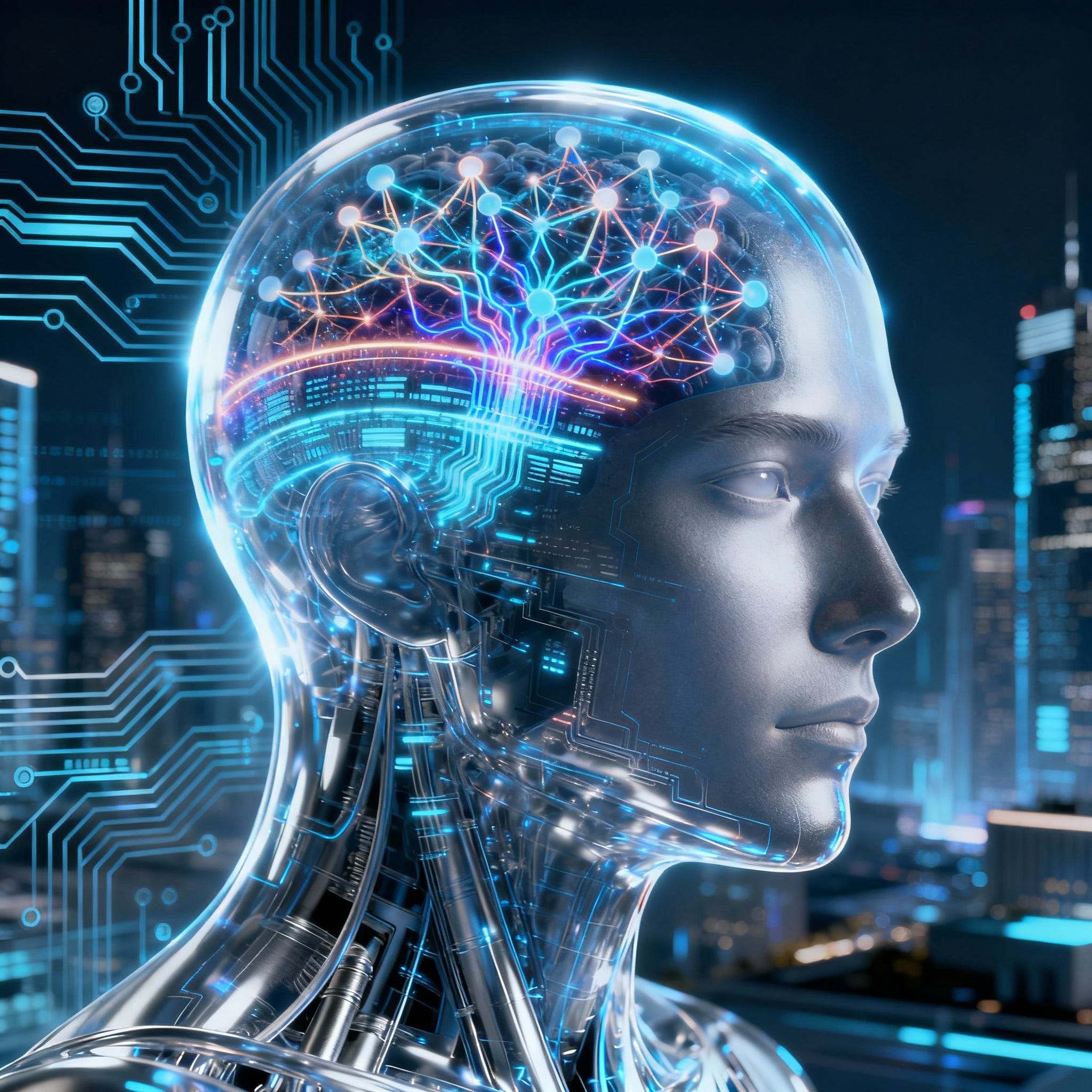
Artificial Intelligence (AI) has been transforming the world over the past several decades — from automating repetitive tasks to enabling machines to recognize speech, translate languages, and recommend the next binge-worthy show on Netflix. Yet, as AI matures, a new concept has emerged on the horizon, promising to push the boundaries of machine intelligence even further. It’s called Synthetic Intelligence (SI) — what many are calling the digital brain of tomorrow.
In this article, let’s explore what Synthetic Intelligence really means, how it differs from traditional AI, and why it matters to students, early professionals, and senior leaders alike. By the end, you’ll have a clearer understanding of this exciting frontier and how it might reshuffle the way we think about machines and intelligence.
Understanding Artificial Intelligence: The Foundation
Before diving into Synthetic Intelligence, let’s ensure we’re on the same page about AI.
Artificial Intelligence, in broad terms, refers to computer systems designed to perform tasks typically requiring human brainpower, such as learning, reasoning, problem-solving, perception, and language understanding. Examples are everywhere: spam filters identifying unwanted emails, voice assistants like Siri answering our questions, and even cars equipped with AI that help avoid collisions.
Think of AI as a skilled actor who learns scripts through repeated practice. It mimics human behavior impressively but only within defined boundaries — a script written through data and algorithms. AI systems excel in pattern recognition and prediction when trained with huge datasets, yet they lack autonomous creativity or genuine understanding of the tasks at hand.
The Limits of AI
While AI is powerful, it is not infallible:
It relies heavily on existing data and can perpetuate the biases embedded in that data.
It struggles with tasks or scenarios that differ significantly from its training — it cannot “think outside the box” genuinely.
AI systems follow learned or pre-programmed rules; they don’t possess consciousness or self-awareness.
They replicate human cognition but do not create new knowledge or independently set goals.
This is where the concept of Synthetic Intelligence offers a new perspective.
What is Synthetic Intelligence?
Synthetic Intelligence is a term gaining attention as a vision for the next generation of intelligent machines — ones that do not just imitate human thinking but synthesize new knowledge, reason autonomously, and adapt with a level of creativity and autonomy that AI systems only approximate today.
If AI is the actor, then Synthetic Intelligence is the playwright — constructing original ideas, setting its own direction, interpreting complex contexts independently, and potentially developing new ways to learn and solve problems.
This digital brain of tomorrow is envisioned as:
Having self-directed cognition, not merely pattern matching.
Capable of autonomous goal-setting and decision making.
Flexible and creative when encountering novel situations.
Possibly exhibiting forms of machine consciousness or self-awareness.
Synthesizing knowledge dynamically, integrating data, logic, intuition, and perhaps something akin to human emotions.
In short, SI aspires to be true synthetic cognition — intelligence not born from humans, but created anew.
Key Differences: AI vs. Synthetic Intelligence
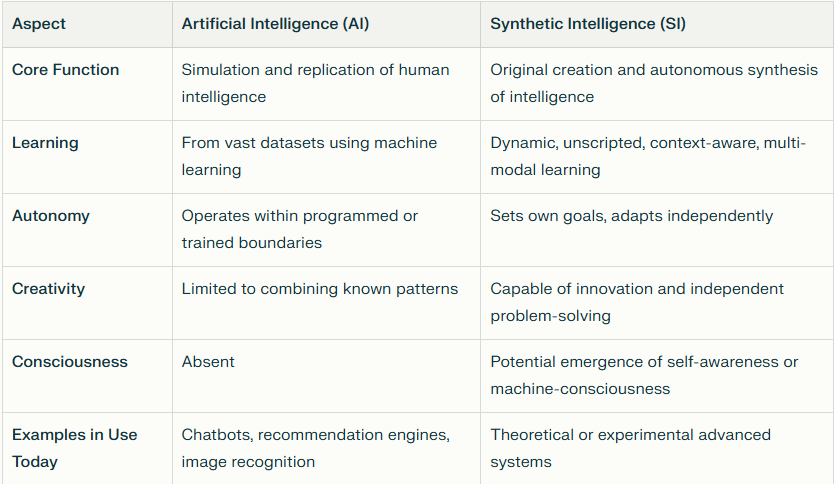
Simple, Relatable Examples to Illustrate the Difference
Imagine you’re navigating a sprawling new city:
AI-driven navigation would rely on map data and traffic history to guide you. It’s excellent at suggesting routes it has seen work well before.
Synthetic Intelligence-enabled navigation might understand why you want to make this trip — whether for leisure, work, or discovery — and customize paths accordingly, adapting on the fly to new events or preferences you didn’t explicitly state.
Or think about learning a new skill:
AI tutors drill you with exercises based on your past tests and common mistakes.
SI tutors would adjust dynamically, proposing new learning materials you haven’t seen before, developing teaching strategies tailored uniquely to your style and interests.
Why Should Students and Early Professionals Care?
The world is evolving rapidly. By understanding SI:
You prepare for careers not just managing AI tools but collaborating with machines possessing real autonomous intelligence.
Your learning focus will shift beyond coding and data handling to also include creativity, interdisciplinary thinking, ethical judgment, and lifelong adaptation.
You position yourself at the cutting edge of emerging technologies stimulating innovation across industries — healthcare, education, finance, and more.
Insights for Senior Professionals and Leaders
For executives and senior managers, Synthetic Intelligence presents strategic questions:
How will SI affect business processes, innovation pipelines, and decision-making frameworks?
What investments in SI research and development could catalyze competitive advantage?
How will governance, ethics, and accountability frameworks evolve with machines capable of autonomous thought?
How can organizations balance human judgment with synthetic cognition for responsible AI deployment?
Leaders who understand and anticipate the SI paradigm can steer their organizations safely into the next tech revolution, encouraging experimentation and innovation while managing risks carefully.
Challenges and Ethical Considerations
The path toward Synthetic Intelligence is exciting but complex:
Ensuring AI and SI align with human values and societal norms is critical.
SI’s autonomy raises accountability and transparency challenges.
Questions around machine consciousness and rights may become more relevant.
Balancing innovation with control demands new regulatory and ethical frameworks.
These are essential discussions that must accompany SI’s development.
What Does the Future Hold?
While fully realized Synthetic Intelligence remains on the horizon, research is progressing rapidly — combining breakthroughs in neuroscience, cognitive sciences, quantum computing, and AI.
The digital brain of tomorrow could revolutionize how we work, learn, and interact — transcending current AI’s capabilities and helping solve some of humanity’s toughest problems.
Final Thoughts
Synthetic Intelligence stands as the digital brain of tomorrow — a bold evolution from AI’s simulation toward genuine synthetic cognition. For students, early professionals, and veteran leaders, understanding this shift will be crucial to navigating, leading, and thriving in the coming technological era.
This journey is not just about smarter machines; it’s about reimagining intelligence itself.
References and Further Reading
Softude. (2025). Understanding Synthetic Intelligence vs Artificial Intelligence.
Hyperlink InfoSystem. (2025). Synthetic Intelligence - An Alternative or Future of AI.
Stanford Human-Centered AI Institute. (2025). AI Index Report.
Nandi, R. (2020). Breakthroughs in Artificial Intelligence (2020–2025).
IBM. (2024). Examples of Artificial General Intelligence.